

The call comes faster than most people expect. You’re still icing your shoulder, still waiting on the MRI results, still figuring out whether you can go back to work next week — and the adjuster is already on the phone with a number. It sounds reasonable. It might even sound generous. And that’s exactly the problem.
I’ve been doing this long enough to recognize the pattern. The offer arrives before the full picture does. Before your doctor has weighed in on whether that disc injury needs surgery. Before anyone has added up the shifts you’ve missed. Before you’ve had a single honest conversation about what the next six months actually look like. The insurance company knows what it’s doing. The question is whether you do too.
The Moment Before You Sign Is the Only Moment That Matters
Here’s what I see regularly in my practice: someone accepts a settlement, signs the release, and then — two months later — gets a diagnosis that changes everything.
A herniated disc that didn’t show clearly on the first scan. A knee that needs surgery the orthopedist initially thought would heal on its own. By then, it’s too late. The release they signed didn’t just close the claim. It closed the door on every future cost connected to that injury.
That’s not a technicality. That’s the entire game.
When you sign a personal injury release in Illinois, you are typically waiving your right to any further compensation from that incident — forever. The insurance company knows this. Their adjusters are trained to move quickly, before your treatment stabilizes and before you understand what you’re actually giving up. A personal injury attorney ma will tell you the same thing from a different coast: the pressure to settle early is universal, and it almost always benefits the insurer, not the injured person.
The first offer is rarely the full picture. It’s a starting position.
What a Complete Claim Actually Includes
Most people have gaps in their understanding of what compensation is supposed to cover. That’s not an accident — it’s where insurance companies quietly do their best work.
Medical Expenses: Past and Future
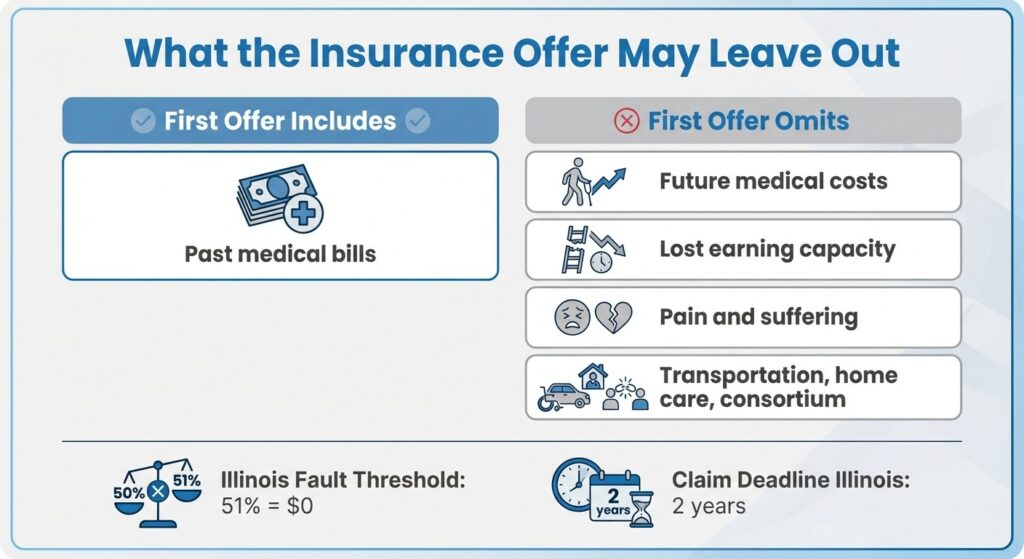
Medical bills are the most visible category, but also the most commonly undercounted. The adjuster might acknowledge your emergency room visit and your first few follow-up appointments. What they often don’t volunteer: future medical expenses.
If your injury requires physical therapy for six months, a surgical consult, or ongoing pain management, those costs belong in your claim. Personal injury claims can include money for medical bills, lost wages, emotional harm, and other losses — and that coverage extends to future treatment, not just what’s already been billed. Expert testimony from a treating physician about your projected care needs can significantly increase what a claim is worth, particularly in back and spine injuries where the full extent of damage takes time to emerge.
Lost Wages vs. Lost Earning Capacity
These are not the same thing, and the distinction matters enormously.
| Category | What It Covers | Documentation Needed |
|---|---|---|
| Lost wages | Days and shifts already missed | Pay stubs, employer letter |
| Lost earning capacity | Reduced ability to work going forward | Medical opinion, tax records, vocational expert |
| Self-employment losses | Income disruption for business owners | Tax returns, client contracts, financial records |
Most early offers account for the first column. The second and third are where significant value gets left behind. If you’re a tradesperson who can no longer lift, or a driver who can’t sit for long periods, that’s lost earning capacity — a separate and legitimate component of your claim that the adjuster’s opening number almost certainly didn’t include.
Pain and Suffering
There’s no receipt for it. But it’s real, it’s compensable, and it’s often the largest component of a serious injury claim.
Illinois doesn’t cap pain and suffering damages in most personal injury cases. The calculation typically involves either a multiplier applied to your economic damages or a per diem approach that assigns a daily value to your suffering over the recovery period. What matters here is documentation: consistent medical records, notes about how the injury affects your daily life, and a clear narrative that connects the accident to your ongoing limitations.
Adjusters will minimize this category if you let them. Don’t let them.
The Categories Nobody Mentions
- Property damage
- Out-of-pocket transportation costs to medical appointments
- Loss of consortium, if the injury has affected your family relationships
- Home care or assistance costs during recovery
None of these are automatic. You have to know to ask for them.
How the Insurance Company Builds Their Number
Understanding how adjusters actually calculate an offer changes how you respond to one.
Insurance companies use claims software — systems like Colossus are well-documented in the industry — that weighs injury type, treatment duration, and medical costs against a database of similar claims. The output is a range. Adjusters are typically authorized to offer somewhere within that range. The bottom of the range is where they start.
What the software doesn’t capture well: the specifics of your life.
It doesn’t know that you coach your kid’s soccer team and haven’t been able to for four months. It doesn’t know that your job requires physical tasks you can no longer perform. It doesn’t know that you’re still waking up at 3 a.m. because the pain won’t let you sleep. Those details matter in negotiation, and they matter even more if a case goes to a jury.
A lowball offer is often a signal, not a final answer. It frequently means the adjuster has assessed the claim as one where the injured person doesn’t have representation and may not push back. Many straightforward claims settle at figures far below what a fully documented claim would support — not because that’s what the case was worth, but because the injured person accepted the first offer without understanding what was missing.
The one question I’d want answered before anything else: Does the offer account for your future medical needs? If you haven’t reached maximum medical improvement — the point where your doctor says your condition has stabilized — you shouldn’t be settling. Full stop.
Illinois Fault Rules and Why They Matter to Your Number
Illinois follows a modified comparative fault system. Here’s what that means in practice:
- Your compensation is reduced by your percentage of fault
- At 20% fault, you recover 80% of your damages
- At 51% fault or more, you recover nothing
Insurance companies will often raise fault as a negotiating lever. They’ll suggest you were partially responsible — you weren’t watching where you were walking, you were following too closely — in order to justify a lower offer. Sometimes that argument has merit. Often it’s a tactic.
If the adjuster is citing your comparative fault as a reason for a reduced offer, you need to understand the actual evidence behind that claim. Witness statements, surveillance footage, police reports, and accident reconstruction all factor in. Don’t accept a fault percentage as given without understanding where it came from.
One more timing consideration worth knowing: Illinois has a two-year statute of limitations for most personal injury claims. That’s your window to file a lawsuit if negotiations break down. It’s long enough that you don’t need to panic — but knowing that deadline exists gives you negotiating leverage. You’re not forced to accept a bad offer just because you feel like the clock is running out.
Before You Respond to Any Offer: A Checklist
You’re not being difficult for asking what you’re owed. You’re doing exactly what any reasonable person should do after an injury that wasn’t their fault.
Work through these questions honestly before you respond to anything:
- Have I reached maximum medical improvement? If not, you don’t know your full medical costs yet.
- Have lost wages been calculated — including future earning capacity? Not just days missed, but long-term impact.
- Has pain and suffering been addressed in a way that reflects my actual experience? Or is it a token number?
- Does the offer include all compensable categories? Or only the ones the adjuster chose to mention?
- Has fault been assigned, and if so, what evidence supports that percentage?
- Am I being pressured to respond before I have complete information?
If you can’t answer those questions confidently, that’s not a personal failing. It means you need more information before making a decision that can’t be undone.
What to Do Right Now
The practical path forward isn’t complicated, but it requires discipline.
Gather your documentation first. Medical records and bills to date, pay stubs or employer statements for missed work, and a plain-language account of how this injury has affected your daily life. That last piece — written in your own words, specific and honest — is more valuable than most people realize. It’s the foundation of any negotiation.
Hold the line on timing. If the offer came before your treatment is complete, tell the adjuster you’re not in a position to settle until you’ve reached maximum medical improvement. That’s a legitimate, defensible position. If they push back, that’s information too — it tells you something about how they’ve assessed your claim.
Recognize pressure for what it is. Urgency from an adjuster is a tactic, not a deadline. The only real deadline is the statute of limitations, and you have two years in Illinois. The adjuster’s timeline serves the insurer’s interests, not yours.
Some claims are straightforward. The injuries are minor, the liability is clear, and a fair settlement can be reached without extended negotiation. But you need to be able to tell the difference between a fair offer and a fast one. Those are not the same thing.
If the numbers feel wrong, or the pressure feels disproportionate, or you’re simply not sure whether what’s on the table reflects what you’re actually owed — that’s the moment to have a conversation with someone who can look at the specifics of your claim. Not to hand it over. Just to understand what you’re looking at before you decide.
The offer on the table is a starting point. Whether it’s also a fair ending point is a question worth answering before you sign.